


1 min read
How Low Should You Go? Your Southern Lawn's Ideal Mowing Height for Summer
If you've ever stepped off the mower, looked at your yard, and thought, "Hmm, that looks a little...scalped," you're not alone. Mowing height is one...
3 min read
Top Turf
:
Updated on September 8, 2026
You've done everything right. You fertilize, you water, you mow at the right height - and your lawn is still just... fine. Not lush. Not that deep green you see two houses down. Before you buy another bag of anything, it might be time to look under the grass instead of at it.
Because here in the Southeast, the problem often isn't what you're feeding your lawn. It's whether your lawn can actually eat.
Soil pH is just a measure of how acidic or alkaline your dirt is, on a scale from 0 to 14. Seven is neutral. Most Southern turf, Bermuda, Zoysia, Tall Fescue, is happiest somewhere between 6.0 and 6.8, which is slightly acidic.
Here's the part most homeowners never hear: pH doesn't feed your grass. It controls access. When soil drifts too far off target, nutrients that are physically present in the ground get chemically locked up where roots can't reach them. Phosphorus, iron, and nitrogen all become harder to absorb.
So you can spread a perfectly good fertilizer on a lawn sitting at 5.2 pH and watch a big chunk of it go to waste. The nutrients are there. The door is locked. That's why a lawn can look hungry no matter how much you feed it and why testing first saves you money.
Low pH has a second effect worth knowing about: it tends to favor weeds and moss over turf. If you've got a lawn that keeps losing ground to weeds even after treatment, sour soil may be quietly stacking the deck.
Southern soil is not one thing, and the differences across Top Turf's service areas are bigger than you'd guess.
Across most of Atlanta, Charlotte, and the Greenville-Spartanburg Upstate, you're dealing with Piedmont clay - that famous red-orange stuff that stains your shoes. Decades of rain leaching through it have left it naturally acidic, often in the 5.0 to 5.8 range. That's below where your grass wants to be.
Nashville is a different story. Middle Tennessee sits on limestone, and limestone is alkaline. Some Nashville lawns test right in the sweet spot without any help, while others, especially near newer construction where topsoil was scraped and replaced, swing acidic anyway.
Dallas-Fort Worth flips the script entirely. Much of DFW sits on Blackland Prairie clay, which often runs alkaline, sometimes 7.5 or higher.
And no matter which city you're in, if your home was built in the last 20 years, there's a good chance your yard's original topsoil left on a truck and got replaced with whatever fill was cheapest. New-construction lawns are some of the most surprising test results we see.
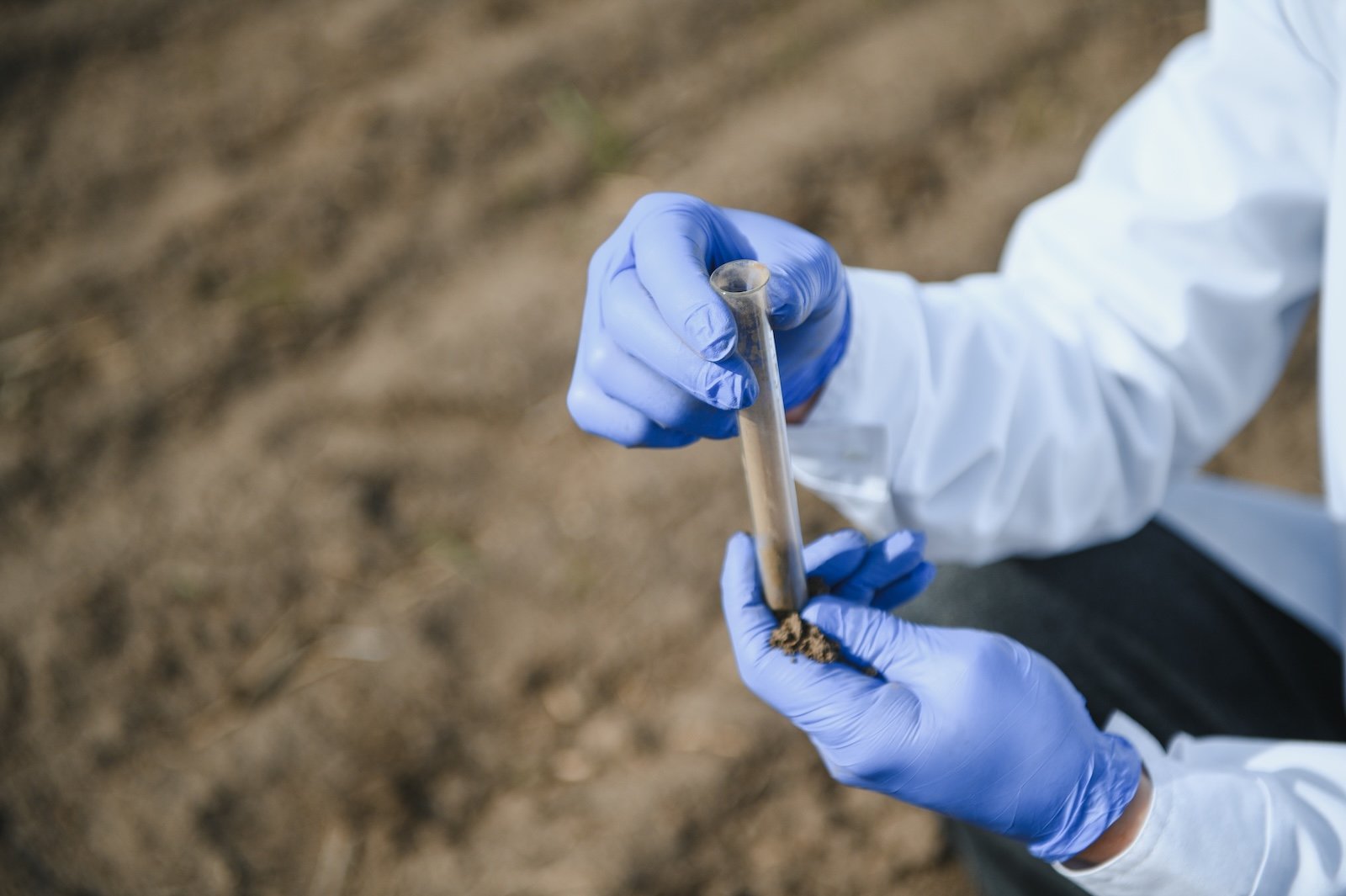
A soil test is genuinely one of the cheapest things you can do for your lawn. Your local Extension office, UT Extension, NC Department of Agriculture and Consumer Services, Clemson, UGA, Texas A&M AgriLife, will run one for a small fee and send back real numbers. Here's how to get results worth trusting:
1. Grab a clean bucket. Plastic, not galvanized metal, which can throw off micronutrient readings.
2. Pull 10 to 15 small samples from around the lawn, not one big scoop from one spot. A trowel or soil probe works fine.
3. Go 4 to 6 inches deep. That's the root zone. A surface scrape tells you about mulch and thatch, not soil.
4. Skip the weird spots. Avoid areas right next to the driveway, foundation, or where the dog goes. Concrete leaches lime into nearby soil and will skew your reading high.
5. Mix it all together, let it air dry on newspaper, and send about a pint.
6. Test problem areas separately. If your backyard struggles and the front looks great, that's two samples, two bags, two labels.
If you have both a Fescue area and a Bermuda area, sample them separately too. Their needs aren't identical.
There's a reason we bring this up in September rather than March.
Lime needs time and moisture to do its job, and fall gives it both. Applied now, it has the cool, wet months ahead to break down and start shifting pH, so by the time your Bermuda and Zoysia break dormancy next spring, or your Fescue hits its big growth push, the soil is finally ready to deliver.
Fall also happens to line up perfectly with aeration. Those holes give lime and nutrients a direct path down into the root zone instead of leaving them sitting on the surface. If aeration and seeding are on your calendar this season, testing beforehand is the single smartest move you can make.
Spring lime isn't useless, it's just late. You'll spend the entire growing season waiting on a correction that could have already been finished.
If your lawn has been stubbornly average for a couple of seasons, or you're tired of throwing product at a problem you can't see, a soil test turns a mystery into a to-do list.
While we don't perform soil testing ourselves, Top Turf handles the rest of the picture: a Fertilization and Weed Control Program built around what your lawn is truly short on, and Core Aeration to get it all where it needs to go. We've been working with Nashville limestone, Carolina and Georgia clay, and DFW prairie soil for years, and we know that the same bag of fertilizer behaves very differently in each one.
If you have questions about your personal soil test results, reach out to your local office - they can help you make sense of the numbers and put together a plan. Give us a call or reach out through our site, and let's find out what your lawn's actually been asking for.
1 min read
If you've ever stepped off the mower, looked at your yard, and thought, "Hmm, that looks a little...scalped," you're not alone. Mowing height is one...
1 min read
Summer in the Southeast is no joke. When temperatures are pushing 95°F in Atlanta, Nashville, and Dallas-Fort Worth, and the humidity is doing its...
1 min read
If your tall fescue lawn has looked a little tired lately — thin in spots, a bit dull, maybe even crunchy underfoot — take heart. It's not dying....